
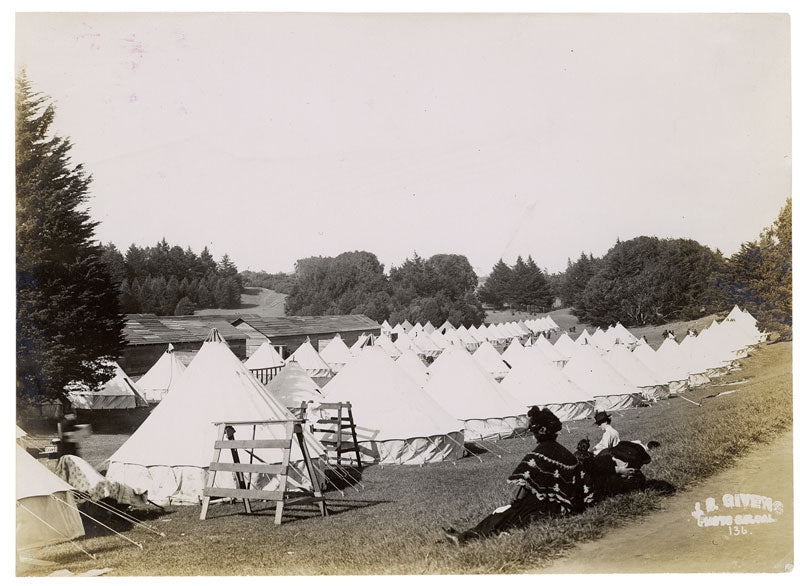
Pictured above: Emergency camp in Golden Gate Park after the 1906 San Francisco earthquake. U.S. National Archives, Records of the U.S. Senate, RG 46.
How the USAF SERE Handbook - Chapter 3 helps civilians build a preparedness plan that still works when normal systems do not.
Most emergency kits are built backward. People usually fill a bag with popular gear and assume equipment equals preparedness. Then a blackout, breakdown, storm or evacuation creates a problem the bag was never designed to solve. The missing piece is usually a method for deciding what matters first.
Chapter 3 of Air Force Handbook 10-644, Survival Evasion Resistance Escape (SERE) Operations offers that method. The chapter is written for isolated military personnel, but its central framework is broadly useful: maintain life, maintain honor and return. Beneath those goals are nine recurring needs: personal protection, sustenance, health, travel, evasion, resistance, escape, communication and recovery.
Civilians should not copy military applications literally. Translate the underlying decisions into lawful actions: protect yourself from the environment, secure safe water and food, manage health, avoid danger, leave unsafe places, communicate clearly and help responders find you. That works in an apartment, on a rural road or in the wilderness.
QUICK ANSWER
Build preparedness around needs, not products. Ask what can harm someone first, meet that need with equipment you understand, preserve calm and lawful judgment, and maintain a reliable way to communicate and return to safety. A small, practiced system beats a large, unfamiliar kit.
The Chapter 3 Framework in Plain English
Chapter 3 groups survival into three goals. Maintain life covers physical requirements. Maintain honor covers conduct under pressure. Return covers communication and recovery. The nine needs are not a rigid sequence. The controlling need is whichever problem can cause the most serious harm next.
- Maintain life. Personal protection, sustenance, health and deliberate travel.
- Maintain honor. Avoid danger, resist panic or manipulation, and leave unsafe situations without abandoning ethics or law.
- Return. Communicate usable information, help others locate you and cooperate with recovery.
Goal One: Maintain Life
Personal protection comes before comfort
Personal protection is the barrier between people and the hazard. In civilian life that may mean seasonal clothing, shelter, lighting, smoke and carbon-monoxide alarms, work gloves, reflective material near traffic or a safe place away from violence. The correct answer depends on the threat. A poncho is useful in rain but irrelevant in a carbon-monoxide emergency; a large food supply does not solve dangerous cold during a roadside breakdown.
Sustenance means safe water before elaborate food
Water supports hydration, medication, food preparation and hygiene. Store a realistic supply in food-grade containers and understand the difference between the boil-water, do-not-drink and do-not-use notices. Treatment has limits: boiling may kill many germs, but it does not remove fuel, heavy metals or other chemical contamination. Be sure to choose familiar, shelf-stable food usable with little water or fuel. Plan for infants, elderly people and those with specific medical diets and possibly pets.

A bread line after the 1906 San Francisco earthquake. When ordinary commerce failed, organized food and water distribution became part of the survival system. U.S. National Archives, Records of the U.S. Senate, RG 46.
Health includes first aid, sanitation and decision-making
A medical plan is more than a first-aid kit. It begins with knowing how to provide basic care, keeping essential prescription medications available, understanding how to clean and protect a wound, and carrying a written summary of important medical conditions, allergies, medications and emergency contacts.
It must also account for the less obvious factors that keep people healthy during an extended emergency: clean hands, safe disposal of human waste, adequate rest and deliberate efforts to prevent additional injuries. Fatigue, poor lighting and stress can turn routine tasks into serious hazards. People may climb over unstable debris, operate generators incorrectly, handle sharp tools carelessly or dismiss a small wound that later becomes infected.
The goal is not to perform advanced medical procedures without proper training. It is to prevent avoidable injuries, recognize problems early, provide care within your abilities and know when professional medical help is necessary. Take CPR and first-aid courses from a qualified provider, practice the skills you learn and never let the equipment in your kit encourage you to operate beyond your training.
FIELD NOTE
A basic wound-care kit is one of the fastest gaps to close, and one of the easiest to get wrong — either an oversized trauma kit nobody trained on, or a dozen loose bandages rattling around a junk drawer. FIELD//MED-1 is built around the same logic as this chapter: a small, purpose-built module that covers cuts, scrapes, blisters and minor burns without asking you to carry (or dig through) more than you need. It's a supplement to training and professional care, not a replacement for either.

American Red Cross workers during the 1918 influenza pandemic. Protective equipment, organized care and repeatable health routines matter during prolonged emergencies. U.S. National Archives, 165-WW-269B-037, NARA ID 45499363.
Travel is a decision, not an automatic response
Movement consumes fuel, water, time and attention. It can also expose a household to traffic, weather, floodwater, fire or closed routes. Move only when such movement will solve a defined problem: leaving an evacuation zone, exiting a damaged building or reaching urgent medical care. Before leaving, confirm the destination, route, alternate route, fuel requirement and how others will know where you went. Waiting can be dangerous, but movement without a purpose can be worse.
Real-World Example: San Francisco, 1906
The 1906 San Francisco earthquake and the fires that followed displaced a massive share of the population. Photographs show the needs clearly: camps created shelter, clothing reduced exposure and bread lines supplied food. The lesson is not to recreate a relief camp. Survival repeatedly becomes a system of ordinary needs delivered under abnormal conditions.
A household can apply the same logic on a smaller scale. Instead of asking, “Do we own survival gear?” ask, “Where will we sleep if this room is unsafe? How much drinkable water is available? Which medication cannot be missed? How will we receive instructions? Where will separated family members meet?” Those questions expose real gaps faster than shopping lists do.

Clothing distribution at Fort Point after the 1906 earthquake. Clothing functioned as protection from exposure, not simply comfort. Cropped from the archival scan for readability. Library of Congress, item 2002722595; no known restrictions on publication.
Goal Two: Maintain Honor in Civilian Life
The military meaning of maintaining honor includes demands most civilians will never face. Its civilian value is the discipline underneath it: do not let fear, urgency or other people push you into reckless, unethical or unlawful choices. Chapter 3 uses the needs of evasion, resistance and escape. For a civilian audience, translate them as hazard avoidance, disciplined resistance to pressure and safe withdrawal.
Avoid danger early
Civilian evasion means staying out of preventable hazards, not hiding from legitimate authorities. Do not drive through floodwater, enter damaged structures, approach leaking containers or remain in a crowd that is becoming violent. Early decisions preserve options. Leaving when officials first advise evacuation is usually easier than leaving after roads, weather and panic deteriorate.
Resist panic, rumors and exploitation
Verify instructions through public-safety agencies, utilities and recognized relief organizations. Protect private information from disaster scams. Avoid broadcasting the location and quantity of household supplies. Within the group, slow decisions down enough to name the threat, compare options and choose the next safe action. Resistance in civilian preparedness is mostly the refusal to let confusion take command.
Leave safely and lawfully
Escape becomes safe withdrawal. Know two exits when possible, keep keys and essential medication reachable, choose an outside meeting point and practice moving children, pets and people with disabilities. Any defensive tool must be securely stored and supported by competent training. A safe exit is generally better than preventable confrontation.
Goal Three: Return
Return means reconnecting with people and support systems. Communication must help someone in the effort to locate you, or for you to locate them. Report who is calling, what happened, injuries, exact location, hazards and the contact method that will remain available. Back up the phone with a battery, written contacts, an out-of-area pre-defined contact, local alerts, a radio and meeting locations should communications fail.
Recovery means making yourself easier to locate and reach. Share travel plans, provide accurate landmarks or coordinates, conserve battery power and tell someone before changing location. If remaining in place is safe, unnecessary movement can delay rescuers. In remote areas, a registered personal locator beacon or satellite communicator may be appropriate, but only if the user understands it before the trip.

Washington, D.C.’s Office of Civilian Defense communications center in 1943. Operators coordinated messages and crews—a historical example of communication enabling recovery. Library of Congress, FSA/OWI Collection, fsa.8b06520.
Practical Takeaway: Build Three Overlapping Layers
Place capability where the problem may happen. An everyday layer handles frequent problems, a vehicle layer supports travel disruptions and a household layer sustains the group during outages or evacuation. The layers should overlap without trying to make every container solve every disaster.
- Everyday: phone, identification, payment form (cash is best), emergency contact, small light, essential medication and weather-appropriate clothing.
- Vehicle: water, shelf-stable food, blanket, seasonal clothing, first aid, visibility equipment, charging power, map and vehicle-specific tools the driver can safely use.
- Household: stored water, food, medication, sanitation, lighting, radio, safe backup power, fire protection, records, pet supplies and ready-to-move bags.
Run this 15-minute preparedness check
- What is the most likely serious hazard where we live, drive or travel?
- What can harm someone first, and what protection answers that threat?
- How much safe water is available right now?
- Which medical, hygiene or sanitation need cannot wait?
- When should we stay, and what would make us leave?
- How will we communicate if cellular service is congested?
- How will family members or responders locate us?
- What rumor, scam or pressure are we most likely to mishandle?
- What is our primary exit, backup exit and meeting point?
FIELD RULE
Write down what worked, what failed and one correction to complete this week. Preparedness improves through practiced decisions and small fixes, not through equipment that remains sealed and unfamiliar.
Sources and Further Guidance
- Air Force Handbook 10-644, Survival Evasion Resistance Escape (SERE) Operations—Chapter 3 describes the isolated person’s needs.
- U.S. National Archives: The 1906 San Francisco Earthquake and Fire—historical overview and archival photographs.
-
CDC: Creating and Storing an Emergency Water Supply—household water storage and treatment guidance.
Editorial note: This independent interpretation is not endorsed by the U.S. Air Force or Department of Defense and does not replace official instructions, professional training or applicable law. Keep each archival credit with its image and confirm the source record before publication.
Share:
YOUR VEHICLE IS NOT A SURVIVAL PLAN