
FIELD NOTES // FIELDCRAFT
THE COLD MAKES EVERY DELAY EXPENSIVE
What Air Force SERE principles teach civilians about surviving winter isolation: heat loss, moisture, shelter, and the decision to stay or move.

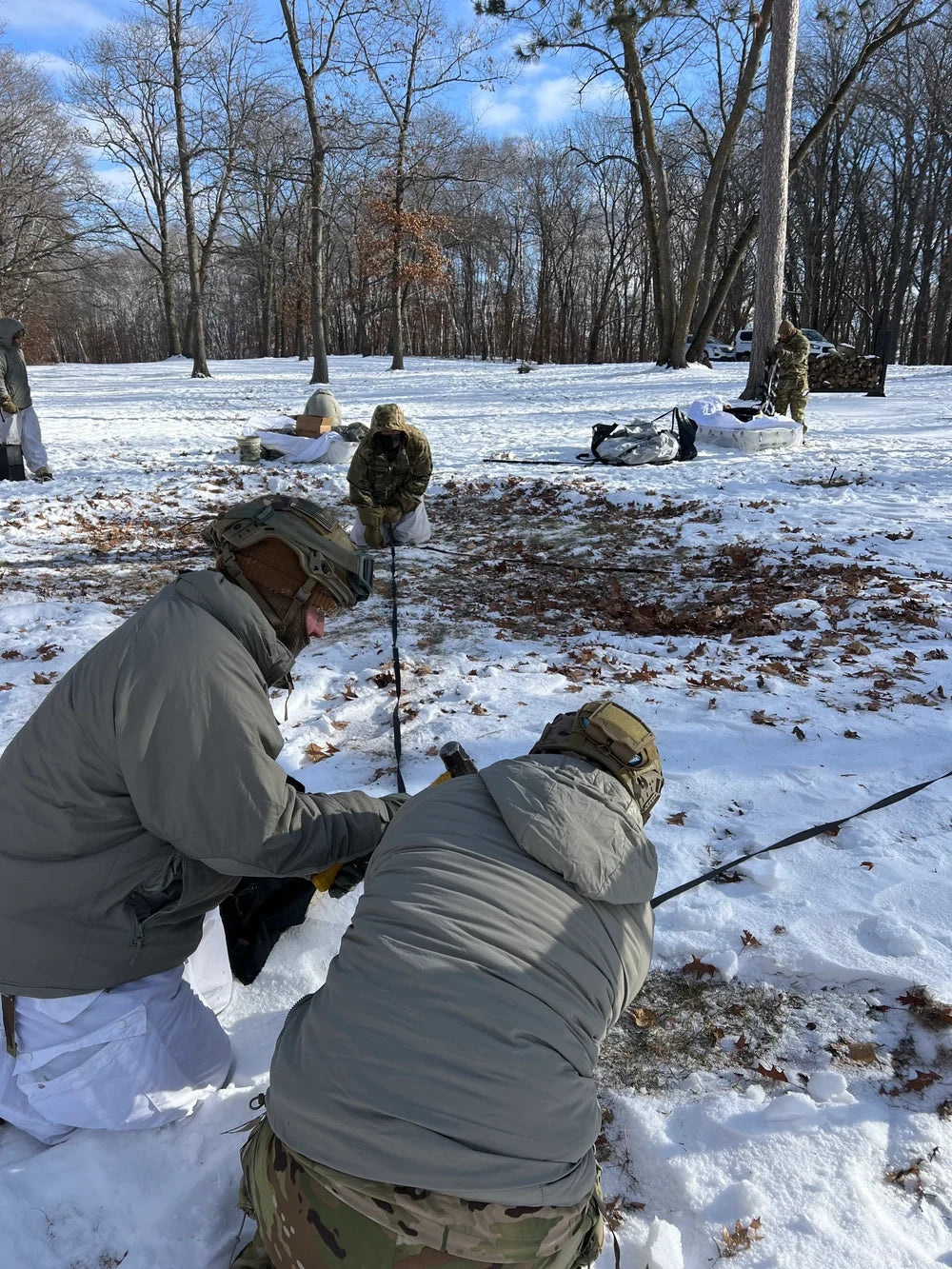
Context image: Air National Guard Security Forces specialists build an arctic tent shelter during a cold weather operations course at Camp Ripley Training Center, Minnesota, January 17, 2024. It does not depict a vehicle breakdown or any event described in this article. U.S. Air National Guard photo by Audra Flanagan. Public domain, per the DVIDS record (rights field reads PUBLIC DOMAIN). The appearance of U.S. Department of War (DoW) visual information does not imply or constitute DoW endorsement. Source record
You left the plowed highway for a rural shortcut a little after three. Now the light is going flat, snow is moving sideways and the thermometer reads 27°F. The car is nose-down in a drift, or it has quit; the engine may or may not start again. The phone shows one bar, then none, on a nearly dead battery. You are wearing a jacket meant for the parking lot. The console holds half a bottle of water, and the cargo area holds a jumble of gear.
The last town did not look far. Two miles, maybe three. Every ordinary assumption says to walk: the distance is short, daylight remains, the jacket felt fine ten minutes ago. Each is a little wrong, and cold makes them wrong faster than people expect. The real question is whether movement solves this problem or turns a vehicle problem into a cold-exposure emergency.
The Air Force trains people to answer that under worse conditions. Its public handbook, Air Force Handbook (AFH) 10-644, covers survival, evasion, resistance and escape (SERE) and calls anyone separated from normal assistance isolated personnel, or IP. From here on this article says driver, traveler or isolated person.
The Desert Makes Every Mistake Expensive covered the opposite climate. The problems differ, but the decision method holds: find the fastest-moving threat, protect the capability you need next, avoid creating a second emergency, keep communication and recovery possible, and reassess as conditions change. In winter, the fastest-moving threat is heat loss.
QUICK ANSWER
If you are stranded in winter, stop and check for immediate hazards such as traffic, fire or a blocked exhaust. Contact emergency services or roadside assistance when you can, and share your location and plan. Get out of wind and precipitation, using the vehicle as shelter when it is safely positioned. Replace or isolate wet clothing, protect your hands, feet, face and head, and insulate beneath your body as well as around it. Avoid exertion that makes you sweat. Conserve phone and flashlight power, make the vehicle visible, and watch everyone for clumsiness, slurred speech or poor judgment. Move only when staying is more dangerous, or when a known safe destination is genuinely close and reachable. Instructions from dispatchers and public-safety officials always override this article.
WHAT SERE COLD-WEATHER KNOWLEDGE IS FOR
AFH 10-644 prepares airmen for isolating events, when support, evacuation and medical care may be delayed. Its cold-region guidance is spread across chapters on survival needs (AFH ch. 3), psychology, medicine, weather, shelter, clothing, fire, water, travel and signaling. What transfers: assess before acting, protect life before equipment, conserve energy, control moisture, shelter early, recognize cold injury, keep communication open, ease recovery and adapt as conditions change. What does not transfer: evading an enemy, hiding from legitimate authorities, captivity and going days without emergency services. A civilian with a phone, a road and a dispatcher should use all three.
THE COLD ATTACKS CAPABILITY BEFORE IT LOOKS DRAMATIC
The handbook says even mild cold lowers efficiency and extreme cold dulls the will to do anything but get warm (AFH §4.9.8.1). Fingers lose dexterity first, then grip and coordination, then speech, memory and judgment. Zippers, knots, lighters and phones get harder. The person deciding whether it is cold enough to act may already be losing the ability to judge.
Hypothermia does not need freezing weather. The handbook calls it a silent killer of people unprepared for a cool, wet day (AFH §5.6.3.2), and rain, sweat or cold water can start it above 32°F. The National Weather Service (NWS) says wind chill describes how cold wind makes people and animals feel, and never cools an object below the air temperature (NWS).
Do not wait for uncontrollable shivering, numb hands or confused thinking before improving shelter and insulation.
CONTROL MOISTURE BEFORE IT CONTROLS YOU
The handbook teaches clothing care with COLDER: Clean, avoid Overheating, Loose and in layers, Dry, then Examine and Repair (AFH §12.3.7). Army safety guidance uses the shorter COLD (Army).
 Context image: a USGS hydrologic technician in a bright green coat and snow goggles during winter fieldwork in western Minnesota, February 7, 2007. It illustrates winter clothing and does not depict any event described in this article. Photo: Upper Midwest Water Science Center, USGS. Public domain, per the USGS media record. Source record · Original file
Hard work in heavy clothing can soak you in dangerous cold, and damp layers insulate poorly once you stop (AFH §12.3.7).
A workable system: a base layer that moves moisture off the skin, insulating layers and a wind- and precipitation-resistant shell, plus dry socks, roomy insulated footwear, gloves or mittens, and head, face and neck protection. Cramming socks into a tight boot restricts circulation (AFH §12.4.1). Cotton insulates poorly when wet, wool keeps most of its insulation (AFH §12.2.1), and synthetics dry easily (AFH §12.2.2.2).
Adjust before the work: open clothing at the neck and wrists, loosen the waist, shed a layer before you sweat and put it back when you stop (AFH §12.4.2). If you are beginning to sweat heavily, you are already wearing too much for the work. The driver adds dry layers early, then sheds one before shoveling.
SHELTER IS HEAT-LOSS CONTROL
Cold shelter has several jobs: block wind and precipitation, reduce contact with frozen ground, trap useful air, preserve dry insulation and give rescuers something to find. The handbook says the need can be measured in minutes (AFH §3.1.1.3) and that late afternoon is a poor time to start looking (AFH §13.1.1).
 Context image: New York Air National Guard airmen erect a shelter from a parachute during Arctic survival training at Raven Camp, Greenland (photo dated May 2, 2011). It does not depict a civilian emergency or any event described in this article. Photo: New York National Guard (courtesy photo). Public domain, per the DVIDS record (rights field reads PUBLIC DOMAIN). The appearance of U.S. Department of War (DoW) visual information does not imply or constitute DoW endorsement. Source record
Insulate underneath. Snow, ice, frozen soil and vehicle metal pull heat out through contact. The handbook warns against sitting on cold logs or kneeling in snow (AFH §11.4.2) and calls for insulation beneath a sleeper (AFH §13.11.2). A blanket on the shoulders does little if you sit on a cold seat. Civilian options, in order: a safely positioned vehicle, a nearby occupied building, carried shelter such as a tarp, bivy or tent, a windbreak with ground insulation, and only when necessary an improvised snow shelter.
This article gives no snow-cave tutorial. Snow caves and tree wells can collapse, suffocate without ventilation, trap carbon monoxide if anything burns, be buried by drifts, sit under unstable snow or branches and hide you from rescuers. A small space warms more easily than a large one, but ventilation stays essential.
WHEN THE VEHICLE IS THE SHELTER
The car is probably the best shelter available: wind protection, a defined location, some insulation, lighting, stored gear and a bigger target than a walker. The NWS says to stay in the vehicle, since leaving in wind-driven snow can quickly disorient you (NWS). The American Red Cross puts the exception at help visible within about 100 yards (Red Cross).
 Context image: a USGS scientist in winter clothing at a monitoring well in a snowy field in Maine, with a utility terrain vehicle nearby (photo dated March 2021). It illustrates winter travel away from plowed roads and does not depict a breakdown. Photo: Jeremiah Pomerleau, New England Water Science Center, USGS. Public domain, per the USGS media record. Source record · Original file
The handbook disagrees, for a reason: it says a wrecked aircraft or vehicle should not shelter people below freezing except in high wind, since it insulates poorly and the floor turns icy (AFH §13.7.4). That assumes a crash site far from help. Follow the NWS, but heed the warning: a car is a shell, not insulation.
Leave at once for fire or smoke, flooding, a position in an active traffic lane, unstable ice, avalanche or falling-object exposure, suspected carbon monoxide (CO) or any other immediate threat.
CO is the quiet danger. The NWS and Red Cross describe running the engine about ten minutes each hour, with the exhaust clear of snow and a window slightly open. That reduces risk without removing it, so do not run the engine continuously just because fuel remains, and do not sleep with it running (Army). Watch for headache, dizziness, nausea, confusion or unusual weakness, which the Centers for Disease Control and Prevention (CDC) lists (CDC). Never run a vehicle in a closed garage.
Inside, put dry clothing, blankets or cushions under and around you, including your seat and floor, and keep essentials within reach so nobody keeps opening doors and dumping warm air.
MOVEMENT MUST SOLVE A BIGGER PROBLEM THAN IT CREATES
A downed pilot may have survival gear, training and a rescue system; a stranded driver has a phone and a coat. Do not imitate military movement because it sounds decisive. The handbook says staying put has helped recover most isolated people (AFH §19.1) and calls leaving safe shelter to travel in bad weather foolhardy outside escape or evasion (AFH §19.1.6.2).
Stay when:
- the spot is reasonably safe and the vehicle is visible
- help is contacted, or the route, visibility or destination is uncertain
- clothing is inadequate, or anyone is injured, fatigued or impaired
Consider moving when:
- staying creates an immediate greater danger
- a substantial occupied shelter is known, visible and close
- conditions, clothing and health allow it, someone knows your plan, and shelter and signaling are not abandoned
Distance lies in snow, darkness and wind. Judging it without landmarks is hard, and in whiteout the handbook says not to travel (AFH §19.5.1). The driver’s “two or three miles” was a guess made in good light.
FIRE IS A TOOL, NOT A PLAN
Fire can provide warmth, melted water, drying, morale, light and a signal (AFH ch. 14). It also needs ignition, fuel, preparation and constant attention. Wet fuel is hard to use, gathering it soaks clothing, open flame can ignite clothing, tents and vehicle materials, and fire does not replace a windbreak (AFH §14.4.3). Prepare dry tinder, fuel and an ignition source you can work in gloves before your hands go numb (AFH §14.4.5); that matters more than owning an impressive fire starter.
Combustion in enclosed spaces can produce fatal CO. Never use an open flame, grill, stove, catalytic heater or improvised burner inside a vehicle. Use flame in a tent or enclosed shelter only when the appliance and shelter were made for that use and every ventilation and clearance requirement is followed.
WATER STILL MATTERS WHEN EVERYTHING IS FROZEN
Cold can dull thirst (Army), yet breathing cold, dry air and working still cost you water (AFH §16.3). Carry water in freeze-tolerant containers, keep it inside the cabin or under your coat, and drink regularly. Warm nonalcoholic drinks help; alcohol impairs judgment and does not protect core temperature. Melt snow instead of eating it; the NWS says eating unmelted snow lowers body temperature (NWS), and the handbook agrees (AFH §16.3.5). Snow is not automatically clean, so treat questionable melt water like any other (CDC), and remember that melting takes fuel. Food supports heat production, but it cannot make up for wet clothing, wind or poor shelter.
COLD INJURIES: KNOW WHEN THE PROBLEM IS MEDICAL
Suspected hypothermia is a medical emergency. CDC lists shivering, exhaustion, confusion, fumbling hands, memory loss, slurred speech and drowsiness (CDC). The handbook adds that shivering usually stops as core temperature falls further, which signals extreme danger, not improvement (AFH §5.6.3.2.1). A measured core temperature below 95°F requires immediate medical attention, but do not wait for a thermometer when serious symptoms are present.
Call emergency services and follow the dispatcher. Meanwhile move the person into shelter, handle a severely cold person gently, remove wet clothing when dry replacements and shelter are available, add dry insulation beneath and around them, and warm the center of the body first. Never give alcohol or give drinks to an unconscious or impaired person.
Frostbite may begin as redness or pain. Skin may then look white or grayish-yellow and feel firm, waxy and numb. Numbness is a warning, not reassurance (CDC). Seek professional care. Do not rub or massage the area, use a fire, heating pad, radiator or other intense heat, or walk on frostbitten feet unless movement is necessary for immediate safety. Do not begin thawing tissue that may freeze again before evacuation (AFH §5.6.3.3.3). Severe frostbite, confusion, unconsciousness, breathing trouble and major injuries all need emergency help.
SMALL INJURIES BECOME LARGE PROBLEMS
A split fingertip, cracked knuckle, blister or burn sounds minor until that hand has to build shelter, work a phone, light a fire, prepare water, drive or help someone else. Black Label Precision’s FIELD//MED-1 is a compact wound-care module for cleaning, covering and protecting minor cuts, scrapes and burns. Its page lists bandages, gauze and pads, a film dressing, antiseptic wipes, ointments, burn gel and nitrile gloves.
It is not a trauma kit, does not replace first-aid training and does not treat hypothermia or frostbite. Serious wounds, uncontrolled bleeding, significant burns, suspected fractures and other emergencies need professional care. Keep supplies dry, accessible and usable with cold or gloved hands, and plan personal medications and condition-specific supplies separately.
COLD AFFECTS EQUIPMENT TOO
People come first, but winter changes how gear behaves. The handbook says electronics must be kept warm so batteries do not cold-soak (AFH §15.1.1). Practical synthesis adds the rest: condensation forms when cold gear enters a warm space, water freezes in containers, plastics and seals stiffen, lubricants thicken, snow jams moving parts and gloves defeat small controls.
The same logic applies to firearms; the handbook notes that many petroleum-based lubricants stiffen in cold (AFH §15.1.2). Black Label Precision’s ColdSnap is a cold-weather firearm lubricant formulated to stay fluid in freezing conditions while lubricating and resisting moisture and corrosion. Clear and render the firearm safe first, apply Coldsnap sparingly to the contact points the firearm manufacturer identifies, and follow its instructions. Prepare gear for the temperature it will meet.
COMMUNICATION, SIGNALING AND RECOVERY
Being warm but unlocatable is still a serious problem. Before leaving, tell someone your route and expected arrival time (NWS). Carry a charged power bank and compatible cable, insulate batteries from severe cold when practical, download offline maps and keep emergency contacts on paper. Know your road name, direction and nearest mile marker. When a call will not connect, a short text sometimes will; give location, vehicle, passengers, injuries and hazards. For genuinely remote travel, consider a registered satellite communicator or personal locator beacon (NOAA).
To be found, use hazard lights, reflective material, a bright panel, a whistle or a flashlight; the NWS adds a bright cloth on the antenna and the hood raised after snow stops. Signaling is not constant activity. It is the deliberate use of limited power and materials to make detection likelier. Once contact is made, conserve battery, follow rescuers’ instructions (AFH §22.3.3) and reassess before changing location.
TWO REALISTIC SCENARIOS
Scenario A: the stranded vehicle
The driver spends two minutes thinking before taking a step. The car is clear of the lane, but the exhaust pipe is half-buried, so that gets cleared first. A call to roadside assistance connects once. The driver gives the road name, the nearest mile marker, the car’s description and the fact that one uninjured person is aboard, then texts the same to a relative and switches the phone to low-power mode.
Every dry layer in the cargo area goes on before the shivering starts. Floor mats and a folded blanket go under the feet and seat. The water bottle moves inside the jacket so it will not freeze, and the flashlight and wound-care module sit within reach. A bright scarf hangs from the antenna. Roughly ten minutes each hour, the driver runs the engine, checks the exhaust, cracks a window and listens for updates. In between, small movements keep blood moving without causing sweat. The driver also checks their own thinking: clumsy fingers, slowed words, fuzzy decisions. At eight, headlights appear. A plow driver finds a car with a visible cloth and a person who is cold but coherent. The driver never left.
Scenario B: remote backcountry isolation
A bush pilot sets down on a snowy gravel bar after an engine problem, forty miles from the nearest airstrip. The aircraft is intact, but the cabin has no heater and a failed door seal, so it cannot do the whole job. The pilot gets out of the wind first, parking the fuselage as a windbreak and stacking gear on the windward side.
Insulation under the body comes next: seat cushions, spare clothing and a foam pad beneath the sleeping bag. A damp base layer is swapped for dry while dry clothing is still within easy reach. A cut across two knuckles is cleaned and covered right away, while the fingers still work. The satellite messenger goes out early with position and condition, then its power is saved. An orange panel lies flat in the open, and a whistle hangs on a cord. Snow is melted with a stove used outdoors, away from the cabin and fuel, never inside. The pilot does not walk anywhere. The shelter keeps improving while there is light, then the pilot rests, eats and drinks on a schedule. Rescuers arrive in the morning and find someone dry, rested and located.
 Context image: California Air National Guard security forces members take down tents during Operation Red Snow cold-weather training near Bridgeport, California (photo dated February 16, 2012). It does not depict a civilian emergency. Photo by Staff Sgt. Emily Suhr (credit as given on the DVIDS record). Public domain, per the DVIDS record (rights field reads PUBLIC DOMAIN). The appearance of U.S. Department of War (DoW) visual information does not imply or constitute DoW endorsement. Source record
WHAT DOES NOT TRANSLATE TO CIVILIAN LIFE
AFH 10-644 plans for hostile territory, enemy observation, captivity, concealment, prolonged isolation without emergency access, military recovery procedures, extreme field-expedient medicine and long-term food procurement. Civilian priorities differ: contact emergency services, follow evacuation and road-closure instructions, make yourself visible, use roads, buildings and communications, and accept qualified help. Do not hide from legitimate authorities, replace medical care with improvisation, gamble on unknown plants or unsafe food, or build complex snow shelters. What survives the translation is the thinking: protect heat, protect function, avoid a second emergency and stay recoverable.
BUILD THE WINTER CAPABILITY BEFORE THE TEMPERATURE DROPS
- Check the forecast and road conditions.
- Share your route and expected arrival.
- Keep the fuel tank adequately filled (Ready.gov).
- Carry winter clothing for the actual forecast, not the heated drive.
- Add dry socks, gloves, a hat and face protection.
- Carry insulation for underneath your body.
- Pack a blanket or temperature-appropriate sleeping bag.
- Store water, food and essential medications.
- Carry a charged power bank and compatible cable.
- Add a flashlight or headlamp with spare power.
- Carry visible signaling equipment.
- Keep a compact first-aid or wound-care module accessible.
- Inspect the spare tire, jump pack, shovel and traction equipment.
- Prepare lawful cold-weather equipment per manufacturer guidance.
- Reassess the kit when the season, route or passengers change.
Cold seldom ends a situation in one dramatic moment. It removes choices gradually: a damp layer, a needless walk, a decision put off. Decide now, while your hands still work, your head is clear and the problem is still small.
SOURCES AND FURTHER GUIDANCE
Air Force Handbook 10-644: chapters, sections and pages used
Primary source: AFH 10-644, Survival, Evasion, Resistance and Escape (SERE) Operations, 27 March 2017. Page numbers below are the handbook’s printed page numbers. Inline links open the PDF at the matching page (PDF page = printed page + 8). Handbook material is paraphrased.
- Ch. 3, The IP’s Needs: pp. 12–16 (§3.1.1.3 Shelter, p. 13)
- Ch. 4, The Psychological Aspects of SERE: §4.9.8.1 Cold, p. 27
- Ch. 5, SERE Medicine: §5.6.3 Cold Related Injuries, pp. 64–67 (§5.6.3.2 Hypothermia, p. 65; §5.6.3.2.1 Mild Hypothermia, p. 65; §5.6.3.3 Frostbite, pp. 65–66; §5.6.3.3.3 Frostnip, p. 66)
- Ch. 11, Proper Body Temperature: §11.4.2 Conduction, p. 166 (§11.1.2 Wind and §11.4.4 Convection, pp. 163, 166, read for context)
- Ch. 12, Clothing: §12.2.1 Natural Materials, p. 168; §12.2.2.2 Synthetic Fibers, p. 169; §12.3.7 Using Layers for IP’s Sleeping System (COLDER), pp. 172–173; §12.4.1 and §12.4.2, p. 174
- Ch. 13, Shelter: §13.1.1 Time, p. 186; §13.7.4 Conditions when Aircraft Should Not be Used as Shelter, p. 211; §13.11.2 Insulation Beds, p. 213 (§13.6–13.8, pp. 206–211, read for the snow-shelter cautions)
- Ch. 14, Firecraft: Ch. 14 introduction, p. 215; §14.4.3 Difficulty of Building Fires in the Arctic Environment, p. 219; §14.4.5 Ignition Source, p. 219
- Ch. 15, Equipment: §15.1.1 Electronic Equipment, p. 231; §15.1.2 Firearms, p. 231
- Ch. 16, Water: §16.3 Water in Snow and Ice Areas, p. 274; §16.3.5 Ingesting Un-Melted Snow, p. 275
- Ch. 19, Land Travel and Evacuation Techniques: §19.1 Decision to Stay or Travel, pp. 418–419 (§19.1.6.2, p. 419); §19.5 Snow and Ice Areas, p. 432 (§19.5.1 Hazards, p. 432)
- Ch. 22, Recovery: §22.3.3 Providing Recovery Forces with Required Information, p. 512 (Ch. 21, Signaling and Communication, pp. 496–510, read by section headings only)
Current civilian and agency guidance
- CDC: Preventing Hypothermia (Winter Weather). Hypothermia warning signs, the 95°F threshold, steps while waiting for help, no alcohol, no drinks for an unconscious person.
- CDC: Preventing Frostbite. Frostbite signs, seek medical care, do not rub or massage, no intense direct heat, do not walk on frostbitten feet unless necessary.
- CDC: Carbon Monoxide. Carbon monoxide symptoms; no camp stoves or flameless chemical heaters indoors; open vents or windows if a tailgate is open.
- CDC: Water Treatment When Hiking, Camping or Traveling. Treating questionable water.
- National Weather Service: Caught in a Winter Storm. Stay in the vehicle; run the engine about ten minutes each hour with the exhaust clear and a window cracked; make the vehicle visible; do not eat unmelted snow; tell someone your route.
- National Weather Service: Wind Chill. Wind chill applies to people and animals and does not cool objects below the air temperature.
- Ready.gov: Car Safety. Keep the gas tank full; vehicle kit items such as a blanket, charger and reflective triangle.
- American Red Cross: Winter Storm Preparedness. Stay in a stranded vehicle unless help is visible within about 100 yards; engine about ten minutes each hour with the exhaust clear and a downwind window slightly open.
- U.S. Army Combat Readiness/Safety Center: Cold Weather Survival for Soldiers (2012). The COLD clothing acronym (Clean, avoid Overheating, Loose and in layers, Dry).
- U.S. Army Combat Readiness Center: Cold-Weather Injuries, Are You Prepared? (2024). Cold can reduce thirst; alcohol impairs judgment; do not idle a vehicle for long periods or sleep in one.
- NOAA: U.S. 406 MHz Beacon Registration. Beacon registration is free and helps search and rescue.
Not relied on: the NWS Winter Weather Safety landing page (weather.gov/safety/winter) held no specific guidance, the Ready.gov Winter Weather page could not be retrieved, and I did not retrieve the NWS Winter Warnings, Watches and Advisories page. No CDC, NWS or Red Cross page I could retrieve says that shivering stopping signals worsening hypothermia, so that point is attributed to the handbook alone.
Image credits
- Air National Guard Security Forces hosts Cold Weather Operations Course. U.S. Air National Guard photo by Audra Flanagan. Source record. Public domain, per the DVIDS record (rights field reads PUBLIC DOMAIN). The appearance of U.S. Department of War (DoW) visual information does not imply or constitute DoW endorsement.
- Hydrologic technician conducting winter fieldwork. Upper Midwest Water Science Center, USGS. Source record. Public domain, per the USGS media record.
- NY Air Guard Airman Train for Arctic Survival. New York National Guard (courtesy photo). Source record. Public domain, per the DVIDS record (rights field reads PUBLIC DOMAIN). The appearance of U.S. Department of War (DoW) visual information does not imply or constitute DoW endorsement.
- Groundwater Science in the Snow. Jeremiah Pomerleau, New England Water Science Center, USGS. Source record. Public domain, per the USGS media record.
- Operation Red Snow tests cold weather training and multi-agency tactics. Photo by Staff Sgt. Emily Suhr (credit as given on the DVIDS record). Source record. Public domain, per the DVIDS record (rights field reads PUBLIC DOMAIN). The appearance of U.S. Department of War (DoW) visual information does not imply or constitute DoW endorsement.
This article is general educational information. It is not medical advice, and reading it does not give you first-aid, cold-weather, wilderness-survival or SERE training. Conditions, health and equipment vary, and no guidance here guarantees an outcome. In an emergency, call 911 or your local emergency number and follow the dispatcher’s instructions, which take priority over anything written here. Black Label Precision is an independent company. The U.S. Air Force, the Department of Defense, the CDC, the National Weather Service, NOAA, the American Red Cross, the U.S. Army and the USGS have not reviewed or endorsed this article or any Black Label Precision product, and their materials are cited only as public sources. Paraphrased handbook material reflects the 2017 edition and may differ from current practice; where it differs from current CDC, National Weather Service or Red Cross guidance, this article follows the current guidance. FIELD//MED-1 is not a trauma kit and does not treat hypothermia or frostbite. Firearm maintenance must follow the firearm manufacturer’s instructions and all applicable laws.
Share:
The Desert Makes Every Mistake Expensive