
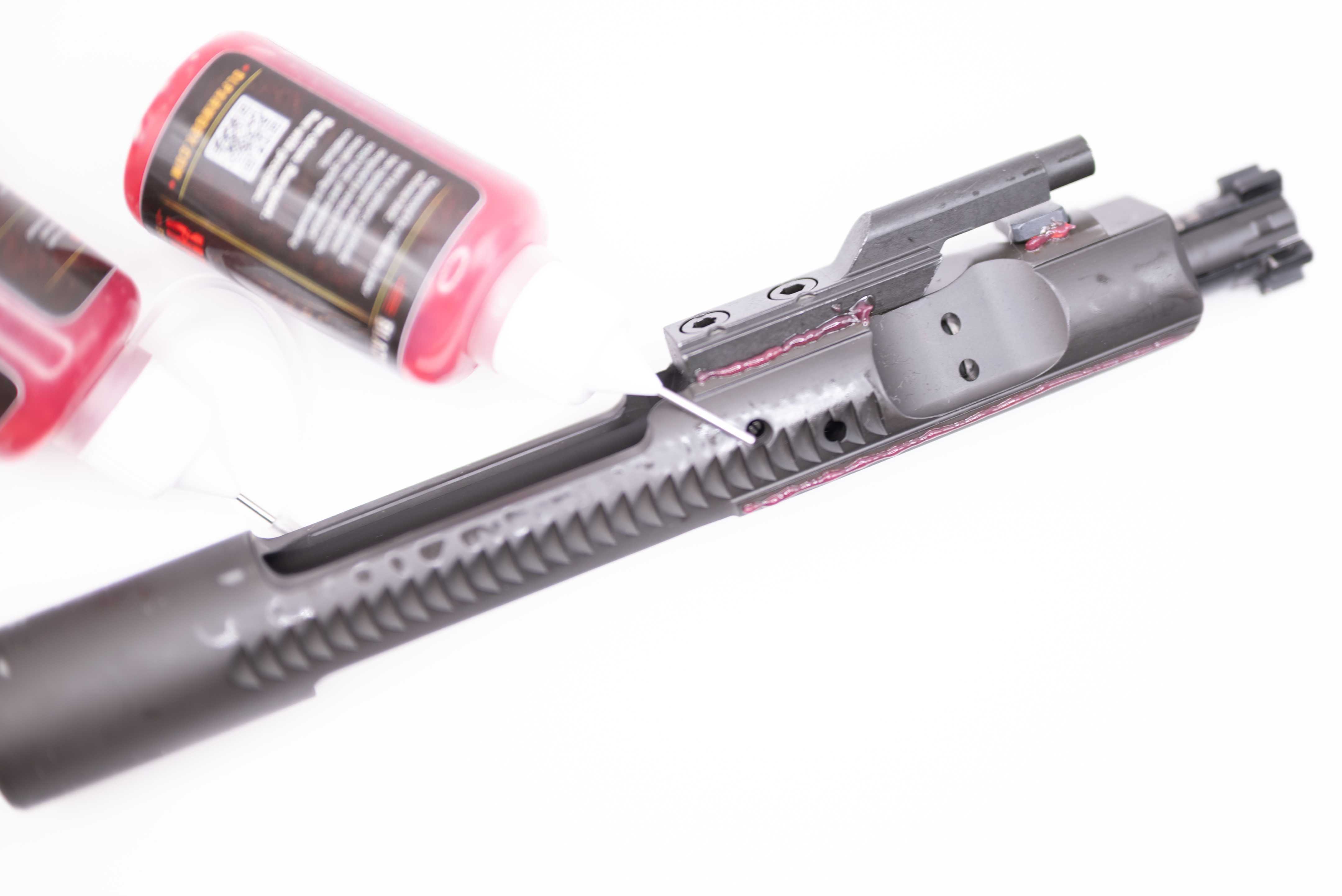
Gun oil and firearm lubricant are often treated as interchangeable terms. Sometimes they are. Sometimes that assumption leaves a firearm coated in the wrong product, carrying too much of it, or running nearly dry when conditions get ugly.
The short answer is simple:
Gun oil is a type of firearm lubricant. Firearm lubricant is the broader category.
That category includes liquid oils, greases, pastes, dry-film products, and formulas designed for particular temperatures or operating conditions.
The name on the bottle matters less than what the product actually does once it is applied. A lubricant must form a protective film, remain where it is needed, tolerate the intended environment, and avoid interfering with the firearm’s operation.
That sounds obvious. So does checking the chamber.
Yet, people still get both wrong.
SAFETY NOTE: Before cleaning or lubricating any firearm, remove the magazine, unload it, and visually and physically verify that the chamber is empty. Keep ammunition away from the work area and follow the maintenance instructions in the firearm’s owner’s manual.
Why Firearms Need Lubrication
A firearm contains surfaces that move against one another under pressure, speed, and heat.
Depending on the platform, those surfaces may include:
-
Slide rails
-
Bolt-carrier contact points
-
Locking lugs
-
Cam paths
-
Trigger contact surfaces
-
Barrel locking surfaces
-
Hinge pins
-
Action bars
-
Other manufacturer-designated bearing points
Even polished metal is not perfectly smooth under magnification. When two dry surfaces move against each other, their microscopic high points make direct contact. That contact creates friction, heat, and wear.
Lubrication places a film between those surfaces. Instead of bare metal dragging across bare metal, the moving components ride on that protective layer.
A firearm may continue to function while dry for some time. That does not mean running it dry is good maintenance.
Lubrication cannot repair damaged components, weak springs, improper assembly, bad ammunition, or years of neglect. It can, however, reduce unnecessary resistance and help properly maintained parts do their jobs.
What Firearm Lubrication Actually Does
A suitable lubricant performs several jobs.
It reduces friction
The most immediate purpose is to reduce resistance between moving surfaces. Less resistance can support smoother cycling and more consistent operation.
It reduces wear
Every operating cycle places some wear on the firearm. Lubrication helps reduce direct metal-to-metal contact, particularly at bearing points and high-load surfaces.
It helps protect against corrosion
Many firearm lubricants also leave a protective film that helps separate metal from moisture, perspiration, and airborne contaminants.
Lubrication is not a substitute for cleaning and inspection after exposure to rain, salt water, mud, heavy perspiration, or humidity. It is one layer of protection—not a force field.
It can make fouling easier to remove
Carbon and combustion residue will still accumulate. A properly lubricated surface may be easier to wipe clean than a dry surface on which fouling has baked directly onto the metal.
It supports reliable movement
A correctly lubricated firearm generally requires less force to cycle its moving components. The key word is correctly. Excess lubricant can collect debris, migrate into areas where it does not belong, and create its own problems.
Gun Oil vs. Grease vs. Purpose-Formulated Lubricant
There is no single product type that is automatically best for every firearm, every contact surface, and every environment.
Gun oil
Gun oil is a liquid lubricant designed—or at least marketed—for firearm maintenance.
Its advantages generally include:
-
Easy application
-
Good coverage across small contact surfaces
-
Ability to flow into narrow areas
-
Simple cleanup and reapplication
-
Better cold-weather potential when properly formulated
Its main disadvantage is the same quality that makes it convenient: oil moves.
A thin oil may migrate away from a bearing surface, seep into adjacent areas, or gradually disappear during extended storage. Under high heat, some oils become thinner and move even faster.
That does not make oil ineffective. It means oil should be selected for the conditions and checked periodically.
Firearm grease
Grease is essentially a lubricant held within a thickening structure. It tends to remain in place better than liquid oil.
Grease may be appropriate for:
-
High-load sliding surfaces
-
Hinge pins
-
Barrel lugs
-
Certain locking surfaces
-
Contact points where oil quickly runs off
For example, Browning recommends grease on the hinge pin, barrel lugs, and forearm bracket of its Citori shotgun. That does not mean every firearm should have grease packed into its action. It demonstrates why the manual matters.
Grease also has tradeoffs. Heavy application can collect dust and fouling. Some greases become noticeably stiffer in cold temperatures. Grease placed in a tight mechanism that was not designed for it may create resistance instead of reducing it.
Use it where the manufacturer recommends it, and use only enough to coat the contact surface.
Purpose-formulated firearm lubricant
“Purpose-formulated” does not describe one physical form. A purpose-formulated lubricant may be an oil, grease, paste, or another delivery system.
The difference is the intended design.
A firearm-specific formula may be engineered around characteristics such as:
-
Film strength
-
Temperature stability
-
Corrosion resistance
-
Viscosity
-
Material compatibility
-
Resistance to migration
-
Performance in the presence of fouling
General-purpose oil may provide some lubrication, but that does not mean it was designed around firearm operating temperatures, storage conditions, finishes, polymers, or contamination from combustion residue.
The real question is not whether an improvised lubricant can make metal slippery.
The question is whether it will remain effective, stay where it belongs, and behave predictably under the conditions in which the firearm is expected to function.
Temperature Changes the Equation
Temperature affects lubricant viscosity—its resistance to flow.
Cold conditions
As temperatures fall, many oils and greases become thicker. A lubricant that flows normally on a workbench may move much more slowly after hours in a freezing vehicle, hunting blind, or outdoor storage area.
If the lubricant becomes too thick, it can increase resistance in the action. Excess grease can be especially problematic in tight mechanisms during extreme cold.
Cold weather does not automatically mean running a firearm dry. It means using an appropriate lubricant in the correct amount.
The importance of climate-specific maintenance is not theoretical. SIG Sauer’s M17/M18 operator manual provides different lubrication guidance for hot, dusty, wet, saltwater, and extreme-cold environments—including a different lubricant requirement for subfreezing operation. The broader lesson is straightforward: environment matters, and the manufacturer’s instructions outrank universal internet advice.
Cold also creates a separate problem: condensation. Moving a cold firearm into a warm, humid environment can cause moisture to form on and inside it. Allow the firearm to acclimate safely, inspect it, remove moisture, and reapply protection as needed.
High heat
Heat causes many oils to thin. A lubricant that starts in the correct location may migrate as the firearm becomes hot.
Sustained firing also exposes lubricants to combustion residue and accelerated evaporation. High-temperature conditions may call for stronger film retention or more frequent inspection and reapplication.
This is the reason behind the two operating-condition formulas in the Black Label Reserve line:
-
Coldsnap is positioned for cold-weather use.
-
Hellfire is positioned for higher-heat operating conditions.
They are not two products because the shelf needed more labels. They address the reality that equipment does not experience every environment the same way.
Maintain what you depend on, and maintain it for the conditions in which you actually use it.
How Much Lubricant Should You Apply?
The real answer is: It's usually less than people often think.
The goal is to leave a controlled film on the correct contact surfaces—not fill the firearm until oil runs out of the takedown pins.
A practical application process is:
-
Unload and clear the firearm.
-
Field-strip it according to the owner’s manual.
-
Remove old lubricant, loose fouling, and visible contamination.
-
Identify the manufacturer-designated lubrication points.
-
Apply a drop or small amount to each specified surface.
-
Spread it into a thin film with a clean patch, swab, or applicator.
-
Reassemble and cycle the action as directed.
-
Wipe away lubricant that pools, drips, or migrates outside the intended area.
-
Complete the manufacturer’s prescribed function check.
Some firearms are designed to operate with more lubrication on certain components than others. An AR-pattern bolt carrier and a striker-fired pistol do not share identical requirements. Neither does an over-under shotgun.
“Run it wet” and “run it dry” are incomplete instructions without a platform, lubricant, environment, and manufacturer recommendation attached to them.
Lubricant should generally be visible as a film that coats the high friction areas.
Lubricating a Firearm for Storage
Operating lubrication and storage protection overlap, but they are not exactly the same job.
During operation, the focus is reducing friction and wear. During storage, the greater concern may be moisture and corrosion.
Before storing a firearm:
-
Make certain it is unloaded.
-
Clean it as required.
-
Remove moisture, fingerprints, and corrosive contamination.
-
Apply a light protective film to exposed metal where appropriate.
-
Keep lubricant away from ammunition.
-
Store the firearm in a secure, dry location.
-
Use humidity control where necessary.
-
Inspect it periodically rather than assuming the safe has stopped time.
A light coat may be applied inside the bore for storage if the manufacturer permits it. Before the firearm is returned to service, inspect the bore and chamber and remove excess oil. Oil or grease should never be allowed to create a bore obstruction.
Do not oil cartridges or intentionally coat ammunition. Lubricant can migrate around primers or cases, attract contamination, and interfere with normal chamber conditions.
A firearm left untouched for years is not maintenance-free simply because it has not been fired. Storage environments change. Protective films migrate. Moisture finds opportunities.
Common Firearm Lubrication Mistakes
Applying too much
Over-lubrication is probably the most common mistake. Excess product can migrate, collect fouling, attract dust, contaminate ammunition, and interfere with components that should remain dry.
More lubricant does not automatically produce more protection.
Running the firearm completely dry
The opposite mistake is assuming that any lubricant attracts dirt and should therefore be avoided. Dry bearing surfaces experience greater friction and wear.
In dusty conditions, the answer is usually controlled application and more frequent maintenance—not blind neglect.
Lubricating the wrong areas
Oil does not belong everywhere.
Certain striker channels, firing-pin assemblies, chambers, ammunition, and other components may need to remain dry. Requirements differ by model, so use the diagram and instructions in the owner’s manual.
Treating every platform the same
A lubrication routine learned on one rifle, pistol, or shotgun should not automatically be transferred to another.
Different operating systems place load, heat, and friction in different locations.
Adding new lubricant over old contamination
Repeatedly adding oil without removing old lubricant and fouling can create an abrasive mixture of carbon, dust, and debris.
Maintenance should include inspection and removal of contaminated lubricant—not just topping off the reservoir that the firearm does not have.
Assuming every cleaner is a lubricant
Some products clean. Some lubricate. Some protect against corrosion. Some are designed to perform all three functions.
Read the label and technical information. A solvent that leaves metal looking clean may also strip away the protective film the firearm needs afterward.
Ignoring the environment
A lubricant selected for a climate-controlled indoor range may not be ideal for extreme cold, desert dust, salt exposure, or extended high-temperature use.
Choose and apply lubricant based on where the firearm will be used—not just where it was cleaned.
Never checking a stored firearm
A firearm can corrode without firing a round. Humidity, condensation, fingerprints, and residue continue working while the firearm sits undisturbed.
Periodic inspection is part of responsible storage.
The Bottom Line
Gun oil is firearm lubricant, but firearm lubricant is not limited to traditional gun oil.
Oil flows easily and works well across many common contact surfaces. Grease stays in place and may be better for certain high-load bearing points. Purpose-formulated lubricants are designed around specific performance characteristics, environments, or maintenance requirements.
There is no universal answer that replaces the owner’s manual.
Use the right product. Put it in the right place. Apply the right amount. Account for the temperature and environmental conditions you'll be in. Always inspect the firearm after use and periodically during storage.
Equipment rarely fails at a convenient time.
Maintain what you depend on.
Black Label Precision is not affiliated with, sponsored by, or endorsed by GLOCK, Browning, or their respective affiliated companies. All manufacturer names and trademarks belong to their respective owners and are used solely for identification, reference, and educational purposes.
Share:
Why Cold Weather Needs Its Own Firearm Lubricant